Most people assume that getting better with money starts with learning more about money.
They think they should learn how to budget, understand compound interest, understand the stock market, and figure out how to make their money work for them.
All of that stuff matters, but it misses the most difficult—and most important—part of personal finance: the person.
A person can understand every financial principle in the world and still lose everything because they're greedy, impatient, insecure, or unable to keep their lifestyle in check.
On the flip side, a little knowledge can go a long way in generating wealth if you are patient, disciplined, and consistent.
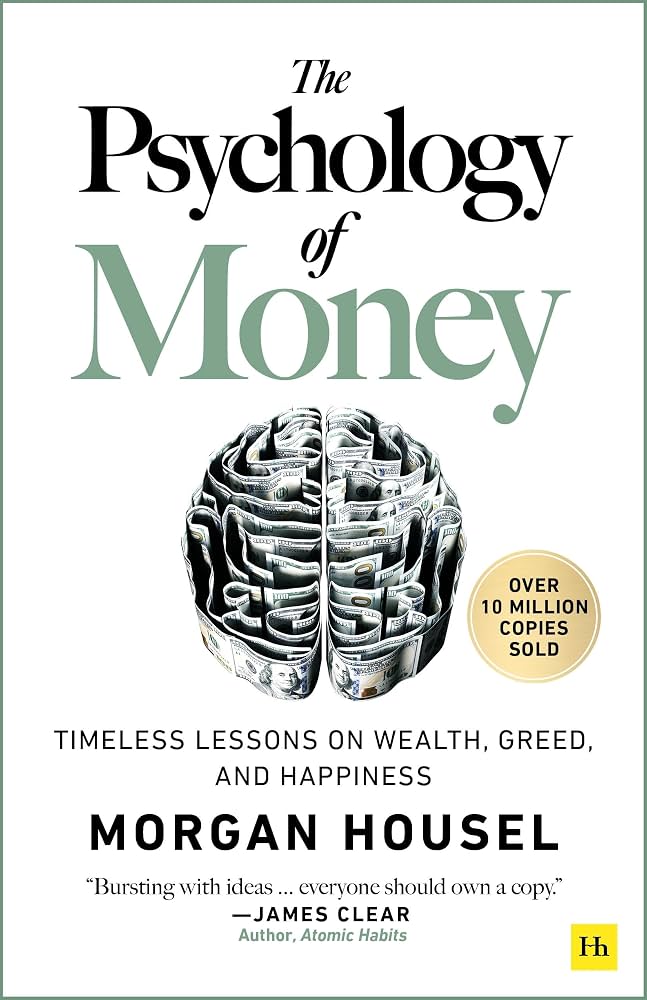
This is the central idea behind Morgan Housel’s The Psychology of Money: Timeless Lessons on Wealth, Greed, and Happiness.
It isn’t really a book about how money works. It’s about how people behave when money is involved—and why financial success has more to do with our behavior than our intelligence.
What Is The Psychology of Money About?
Housel’s argument is simple:
Doing well with money has more to do with how you behave than what you know.
Financial decisions are usually presented as mathematical problems. If you earn this much, save that percentage, and get a specific return, you’ll eventually arrive at the holy land of financial freedom.
But almost no one makes financial decisions inside a spreadsheet, using cold logic and rational decision-making processes. Like most decisions we make, they're made based on behavioral patterns and emotions.
We make them at the dinner table, in the middle of a market crash, after watching our neighbor buy a new car, while arguing with a spouse, or when we’re afraid that everyone else is getting rich without us.
Money is mathematical, but our relationship with it is emotional. And that relationship determines how we treat it, which in turn, determines how it will treat us.
Housel explores that relationship through short chapters about wealth, risk, luck, greed, saving, compounding, uncertainty, and freedom.
Instead of giving the reader a rigid financial program, he uses stories to explain why intelligent people regularly make terrible decisions—and why ordinary people sometimes quietly become wealthy.
Everyone Is Playing a Different Game
One of the book’s strongest ideas is that nobody is crazy when it comes to money.
People make decisions based on the version of the world they have experienced.
Someone who grew up during the Great Depression may treat debt and risk differently from someone whose entire adult life occurred during a bull market. A person raised in a stable, financially literate household is playing a different game from someone who grew up watching every dollar disappear as soon as it arrived.
Let's say you grew up in public housing projects, where money was usually connected to immediate survival.
When you come from that environment, long-term financial planning can seem like a luxury. It’s difficult to think about what your money might accomplish in 30 years when you’re worried about what it needs to do by Friday.
That background can teach resourcefulness, but it can also create destructive habits. You may spend money as soon as you get it because experience has taught you that resources never remain available for long. You may view every opportunity as your last chance. You may take excessive risks because slow, patient progress doesn’t feel real.
Someone observing those decisions from a comfortable background may call them irrational. From inside that person’s experience, however, they make perfect sense.
Understanding this doesn’t mean excusing poor decisions. It means recognizing where they come from. You cannot change your financial behavior until you understand the experiences and beliefs producing it.
To illustrate this point, Housel delivers a powerful line that everyone should remember:
“Some people are born into families that encourage education; others are against it. Some are born into flourishing economies encouraging of entrepreneurship; others are born into war and destitution. I want you to be successful, and I want you to earn it. But realize that not all success is due to hard work, and not all poverty is due to laziness. Keep this in mind when judging people, including yourself.”
Getting Wealthy and Staying Wealthy Are Different Skills
Getting money often requires optimism, confidence, and risk.
Keeping it requires humility, patience, and some degree of fear.
In Housel's own words, "There are a million ways to get wealthy, and plenty of books on how to do so. But there's only one way to stay wealthy: some combination of frugality and paranoia."
This distinction is one of the most valuable lessons in the book.
The behavior that helps you build wealth can become the same behavior that destroys it.
An entrepreneur may become successful because he is willing to bet on himself. But if every success convinces him to make a larger bet, eventually he may encounter one he cannot survive. This is because survival matters more than optimization, but we often confuse the two.
You do not need to make the perfect financial decision every time. You need a system that lets you stay in the game long enough for good decisions to compound. Interestingly enough, this is how professional poker players think.
Gambling is not something often associated with financial acumen, but there is a lesson here. Poker pros understand that if you play correctly, within a system, in the short term you may fold hands that would have won big or lose some that normally win, but over time, you will make more than you lose.
If we apply this idea to more traditional financial endeavors, that means maintaining liquidity, avoiding obligations that leave no room to breathe, and refusing to risk what you need for something you merely want.
The best plan isn’t necessarily the one that produces the greatest theoretical return. It’s the one you can continue following when reality refuses to cooperate.
The Most Important Part of a Plan
Most financial plans are built around what we expect to happen.
We expect our income to remain stable. We expect an investment to produce a certain average return. We expect inflation, interest rates, markets, and our health to remain within a reasonable range.
Then life happens.
The economy changes. A business fails. Someone becomes ill. An investment performs differently than its historical average. A supposedly secure job disappears.
A financial plan that only works when everything goes according to plan is not much of a plan.
“Things that have never happened before happen all the time.”
― The Psychology of Money
As the musical group Outkast says in their hit song "Ms. Jackson," "You can plan a pretty picnic, but you can't predict the weather."
You need to make sure part of your plan includes preparation for this "bad weather."
Housel calls this a “margin of safety.” It means leaving space between what you believe will happen and what you can survive if you’re wrong.
This might mean saving more than a calculator says is necessary. It may mean maintaining access to capital, keeping fixed expenses manageable, or accepting a lower potential return in exchange for greater control.
You have to be a little paranoid but also shed certain ideas. For example, it does you no good to pay down all of your debt if it leaves you with so little cash that you can't cover daily living expenses or drains your emergency fund. Should something happen, then you'll end up right back in debt—ironically enough—because you didn't
Certain habits, like being debt-free and efficient, look good on paper. However, in reality, the plan that is most resilient—rather than the quickest or prettiest—is the one you want to invest in.
“Planning is important, but the most important part of every plan is to plan on the plan not going according to plan.”
-Morgan Housel, "The Psychology of Money"
Wealth Is What You Don’t See
One of Housel’s most useful distinctions is the difference between being rich and being wealthy.
“Savings can be created by spending less. You can spend less if you desire less. And you will desire less if you care less about what others think of you.”
― The Psychology of Money
Rich is visible.
You can see the car, the house, the watch, the clothes, and the vacation. Spending money is the easiest way to convince other people you have money.
“Spending money to show people how much money you have is the fastest way to have less money.”
Wealth is invisible.
Wealth is the money you haven’t spent. It is the reserve that gives you options, the assets producing future income, and the ability to absorb a setback without desperation.
This creates a strange problem: we often imitate the visible behavior of supposedly wealthy people while having no access to their balance sheets.
You see the $100,000 car. You don’t see the loan.
You see the house. You don’t see the mortgage payment.
You see the lifestyle. You don’t see the anxiety required to maintain it.
Much of what society calls wealth is simply consumption. Actual wealth is stored freedom.
“Money’s greatest intrinsic value—and this can’t be overstated—is its ability to give you control over your time.”
― The Psychology of Money
Control Is the Best Thing Money Can Buy
Housel argues that the highest form of wealth is control over your time.
Money gives you the ability to decide where you go, what you work on, whom you work with, and how long you must tolerate a bad situation.
That freedom exists on a spectrum. You don’t need to retire at 35 or accumulate millions of dollars before money begins buying control. Many times, that freedom is psychological and emotional, rather than a physical representation for others to see.
An emergency fund gives you the freedom to handle a repair without panic. Low fixed expenses make it easier to leave a terrible job. Accessible capital allows you to recognize an opportunity without begging a bank for permission.
The value of money is not merely what you can purchase with it. Its deeper value is the number of decisions you can make without fear dictating your response.
This is also where the book aligns closely with the philosophy behind Unlimited Life Concepts. The objective isn’t simply to accumulate a large number on a statement. It is to create a financial system that provides greater control, flexibility, and durability.
Money should support your life. Your life should not become a machine built solely to support your financial obligations.
Said another way, when you find yourself working just to live, then you are the most trapped. The idea is that you make enough money, save enough money, and do so in a way that does not make you feel trapped.
“Use money to gain control over your time, because not having control of your time is such a powerful and universal drag on happiness. The ability to do what you want, when you want, with who you want, for as long as you want to, pays the highest dividend that exists in finance.”
― The Psychology of Money
Knowing When You Have Enough
The idea of a "finish line" or having "made it" is an illusion. If you treat money like a competition, you will forever be locked in a game that is impossible to win.
Someone will always have a larger house, a more profitable business, a higher net worth, or a better year in the market. If your definition of success depends on staying ahead of other people, you can never feel secure.
Housel says one of the most difficult financial skills is getting the goalpost to stop moving, because if you think like this, enough will never be enough. But let's be clear on exactly what "enough" does not mean.
Enough does not mean abandoning ambition. It means knowing what you are unwilling to risk for something you do not need.
There are people who achieved more wealth than they could ever spend and then destroyed their lives trying to acquire a little more. The problem wasn’t mathematical. It was psychological.
If you never define enough, every success merely finances a larger appetite.
That makes lifestyle inflation especially dangerous. Your income increases, your spending expands to meet it, and your life becomes more expensive without becoming more secure. You appear richer while remaining just as dependent on the next paycheck.
Building wealth requires a gap between what you earn and what you consume. Preserving freedom requires resisting the urge to close that gap every time your income rises.
Luck, Risk, and the Stories We Tell
Successful people naturally want to believe their outcomes are entirely the result of intelligence and effort. Unsuccessful people tend to believe that they are unlucky.
However, reality is more subtle and nuanced than this.
Hard work matters. Discipline matters. Skill matters. Luck also matters.
“Luck and risk are both the reality that every outcome in life is guided by forces other than individual effort. They are so similar that you can’t believe in one without equally respecting the other. They both happen because the world is too complex to allow 100% of your actions to dictate 100% of your outcomes. They are driven by the same thing: You are one person in a game with seven billion other people and infinite moving parts. The accidental impact of actions outside of your control can be more consequential than the ones you consciously take.”
― The Psychology of Money
Bill Gates was exceptionally intelligent and driven, but he also attended one of the rare high schools with access to a computer during a period when most universities didn’t have one. That doesn’t invalidate his work, but it does place it in context.
The same is true of failure. Not every bad result proves that the decision was foolish. Sometimes a reasonable decision produces a bad outcome because risk became reality.
Again, we can find our inspiration at the poker table. Where a
We often judge decisions exclusively by their outcomes because the outcome is visible. But a good decision can end badly, and a reckless decision can temporarily succeed.
The lesson is not that effort is meaningless or that outcomes are random. It is that we should be more humble when explaining success and more careful when copying it.
You can imitate another person’s actions without inheriting their timing, opportunities, tolerance for risk, or luck.
What the Book Gets Right
The greatest strength of The Psychology of Money is Housel’s writing.
He takes ideas that could have been buried beneath academic language and turns them into short, memorable stories. The chapters are accessible even if you know very little about investing.
More importantly, he understands that financial behavior cannot be separated from human nature.
Fear matters. Ego matters. Envy matters. Your childhood matters. Your time horizon matters. Your need for social approval matters.
The book also avoids pretending there is one perfect financial strategy for everyone. Different people have different goals, backgrounds, responsibilities, and temperaments. A strategy you cannot maintain is not a good strategy for you, regardless of how well it performs in a simulation.
His strongest principles are timeless:
- Spend less than you earn.
- Leave room for error.
- Avoid risks that can remove you from the game.
- Give compounding time to work.
- Don’t confuse visible consumption with wealth.
- Define enough before the world defines it for you.
- Use money to gain control over your time.
None of those ideas are flashy. That is precisely why they work.
“Be nicer and less flashy. No one is impressed with your possessions as much as you are. You might think you want a fancy car or a nice watch. But what you probably want is respect and admiration. And you’re more likely to gain those things through kindness and humility than horsepower and chrome.”
― The Psychology of Money
Where the Book Falls Short
Despite the title, The Psychology of Money is not a rigorous examination of psychology.
Readers expecting neuroscience, clinical research, or a systematic treatment of cognitive biases may be disappointed. Housel is primarily a storyteller and financial writer. His evidence often comes from historical examples and anecdotes rather than controlled research.
The book can also become repetitive. Several chapters return to the same underlying message: uncertainty is unavoidable, compounding requires time, and behavior matters more than technical sophistication.
That repetition makes the lessons memorable, but some readers will feel that the book could have made its argument in fewer pages.
It also offers principles more readily than implementation. Housel explains why you need flexibility, savings, and a margin for error, but he doesn’t provide a detailed system for creating them.
That isn’t necessarily a flaw. It just means this book is better at changing how you think than telling you exactly what to do Monday morning.
Is The Psychology of Money Worth Reading?
Without a doubt!. In fact, I would give The Psychology of Money 4.5 out of 5 stars.
It is not a comprehensive financial manual, and it isn’t as psychologically rigorous as its title might suggest. What it does exceptionally well is explain why financial knowledge alone is insufficient.
Most people do not fail financially because compound interest is too difficult to understand. They fail because consistency is difficult, comparison is powerful, uncertainty is uncomfortable, and patience is boring.
The book’s enduring lesson is that wealth is not merely an amount of money. It is a way of organizing your behavior so that money creates security and freedom rather than anxiety and dependence.
Education gives you better information. A sound financial system helps you continue making good decisions when emotion, uncertainty, and life interfere.
That is where insight must become implementation.
Unlimited Life Concepts helps individuals and families explore systems designed around greater control, stronger cash flow, financial resilience, and lasting wealth.
If the ideas in The Psychology of Money resonate with you, the next step is examining whether the way you currently handle money reflects the life you’re trying to build.
Because knowing how money works is valuable, but knowing how you work around money is where the real change begins.